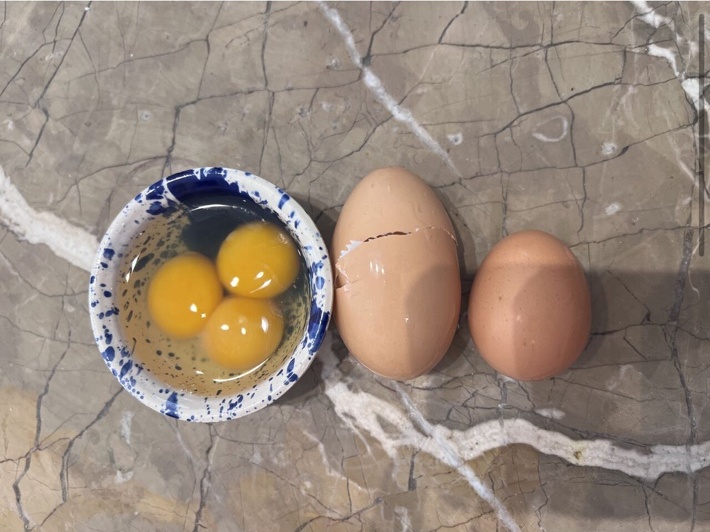
A triple-yolk egg is apparently incredibly rare. We had one recently. Sadly, it did not pay the school fees.
It did, however, get me thinking about rarity and value, and about one of the numbers I spend a surprising amount of time looking at in Mallorca property: euros per square metre.
€/m² is useful. It gives buyers a common language for comparing properties that may otherwise look difficult to compare. But it can also create a false sense of precision, particularly when it is being used to justify an asking price.
A precise number built on imprecise information
The calculation itself could hardly be simpler. Divide the price by the stated area and you have a number that looks reassuringly objective.
The difficulty is everything sitting behind those two inputs.
Was the comparable renovated? Did it have a sea view? Was it on a noisy road? Was the stated area actually correct? Are we comparing built area with usable internal area? Has one figure included covered terraces while another has not? What was the orientation? The plot? The condition? And perhaps most importantly, was the asking price ever the selling price?
Take an average of enough imperfect comparisons and you end up with a very precise-looking number built on some decidedly imprecise information.
For a buyer, that matters. The job is not to find a number that supports the asking price. It is to understand what the available evidence actually tells us about the property.
Asking price is not comparable evidence
This sounds obvious, but it is surprisingly easy for asking prices to become accepted as market evidence simply because they are visible.
If several nearby properties are advertised at similar €/m² levels, that is useful information about seller expectations. It does not necessarily tell us where buyers are transacting.
A property that has been sitting on the market for a year at €10,000/m² has not proved that the market is €10,000/m². It has proved that somebody is asking for it.
Achieved prices are more useful, but even then the context matters. A recently renovated turnkey house and a tired house requiring substantial work may occupy the same street and have broadly similar dimensions while representing very different propositions.
Even the square metre can be slippery
In Mallorca, the denominator deserves almost as much scrutiny as the price.
Marketing particulars, cadastral information, registry information and architectural measurements do not always describe a property in exactly the same way. Terraces, porches, garages, basements and other spaces can be treated differently, and a seemingly small change in the stated area can materially change the €/m² figure.
That does not make the metric useless. It simply means the inputs need to be understood before the output is trusted.
Then there is scarcity
This is where Mallorca becomes particularly interesting.
There are streets, buildings and small pockets of the island where so little genuinely comparable property changes hands that conventional valuation evidence becomes thin very quickly.
Averages become less helpful because the buyer is not choosing between twenty interchangeable units. They may be looking at one of only a handful of properties with a particular position, view, orientation or access that matters to them.
But rare is not, by itself, a valuation methodology.
Our triple-yolk egg proves that.
Scarcity becomes economically interesting when it meets genuine demand.
When the question changes
At that point, the buyer's question is no longer simply:
“What did the last one sell for?”
It may also be:
“If I walk away from this one, when will I get the chance to buy another?”
That is not an argument for overpaying. Quite the opposite. It is an argument for understanding exactly what you are buying, testing the evidence properly and recognising where the evidence stops being definitive.
Sometimes the comparables tell you to negotiate hard. Sometimes they tell you that the asking price is detached from reality. Sometimes the scarcity of the opportunity itself legitimately affects what the property is worth to the market and to a particular buyer.
Price and value are not quite the same thing
€/m² is one piece of evidence. A useful one. I would be wary of any valuation discussion in Mallorca that ignored it completely.
But I would be equally wary of one that treated it as the answer.
The better question is what sits behind the number: the quality of the evidence, the differences between the supposed comparables, the depth of demand and the likelihood of finding a genuine substitute if you walk away.
Knowing the difference between price and value can be a much harder number to put into a spreadsheet.
The Iberian Office represents the client, not the property.
← Back to Insights